If you are undocumented, it is possible for you to attend graduate school! It is estimated that 12.8% of all undocumented students in higher education are in graduate or professional programs, so you are not alone. We hope that moving from college to graduate school is an exciting opportunity for you. However, we realize that it can be stressful to make that transition as an undocumented student. We have compiled a list of key information and resources to help you navigate the graduate school application process.
Please keep in mind that this resource page is for informational purposes only and does not constitute or replace professional legal advice. It is important to consult with an experienced and trustworthy immigration representative or attorney to receive answers and support for specific legal questions. Additionally, the information provided is current to the publication of this resource page. Please be sure to verify any authenticity and trustworthiness of links prior to connecting with any resource.
In this page, you can find more information about the following:
- UNDERSTANDING THE GRADUATE SCHOOL CONTEXT
- Brief overview of the graduate school context
- Common terminology (such as tuition and teaching assistantships)
- Overview of the graduate school application process
- Information about graduate school entrance exams
- Institutional and organizational support
- Personal stories and additional reading recommendations
- APPLYING TO GRADUATE SCHOOL: NEXT STEPS & RESOURCES
UNDERSTANDING THE GRADUATE SCHOOL CONTEXT
Brief overview of the graduate school context
Pursuing graduate school is different from the experience of navigating college for several reasons. First, graduate degree programs may require applicants to take an entrance exam like the Graduate Record Examination (GRE) or the Law School Admission Test (LSAT) (more information on how to prepare for entrance exams as an undocumented student below). For doctoral degrees in particular, admission into the program may be based on your research interests and fit with current faculty members who could serve as potential advisor(s).
It is also important to note that while some states offer access to in-state tuition rates or financial aid options for undocumented students, these opportunities may not extend to graduate studies. (Check out this map created by the Higher Education Immigration Portal which features information about state-level policies with respect to tuition, admission, and state financial aid policies across the country.)
In your search for graduate school options, you may encounter programs, for example, that very clearly take into account the California State Dream Act (AB 130 and AB 131) when factoring in your financial aid for graduate studies. Alternatively, you may encounter graduate school programs that believe such policies are limited to undergraduates only. As you navigate the graduate school application process, it is imperative to stay informed about specific state policies, legal protections, and resources available within your specific university and state of residence. It is also helpful to connect with fellow undocumented students who are currently in graduate school or who have successfully graduated to learn about their experiences and advice.
Common terminology (such as tuition and teaching assistantships)
The following is a detailed list of key terms you will encounter in this page:
- “Deferred Action for Childhood Arrivals (DACA)” is a federal program that offers 2-year work permits and temporary relief from deportation to eligible undocumented youth and young adults based on a set of requirements. For additional information on DACA, we encourage you to visit USCIS’ official website: Consideration of Deferred Action for Childhood Arrivals (DACA), as well as our “Legal Resources” page.
- “State financial aid” is a type of assistance that is provided by the state’s government to students towards their higher education expenses. Please note that not all states offer some type of state financial aid for undocumented students. Moreover, these opportunities may not extend to graduate studies. Thus, it is important to check on the policies for the specific programs and universities you are considering.
- “Teaching” and “research assistantships” in the graduate school context typically refer to paid employment opportunities offered by graduate programs to students who are in good academic standing and have employment authorization.
- “Tuition” refers to the cost of attending a college or university, which can vary widely depending on the type of institution (for example, if it is a public or private college), the geographical location, graduate degree you are pursuing, amongst other factors.
- “Out-of-State” tuition is a type of tuition that tends to be more expensive than “in-state” tuition. Whether you qualify for in-state or out-of-state tuition is based on how the state defines who is considered a resident of the state or not for tuition purposes. To qualify for in-state tuition rates, students typically have to physically reside in the state they are seeking to pursue higher education for a certain period before enrollment and must meet other eligibility criteria.
- “Undocu-friendly” is a term commonly employed by allies and schools to denote whether an individual or setting is supportive (that is, “undocu-friendly”) to undocumented students. Please note that the level of support varies and encompasses various categories such as emotional, financial, legal, or social support.
Overview of the graduate school application process
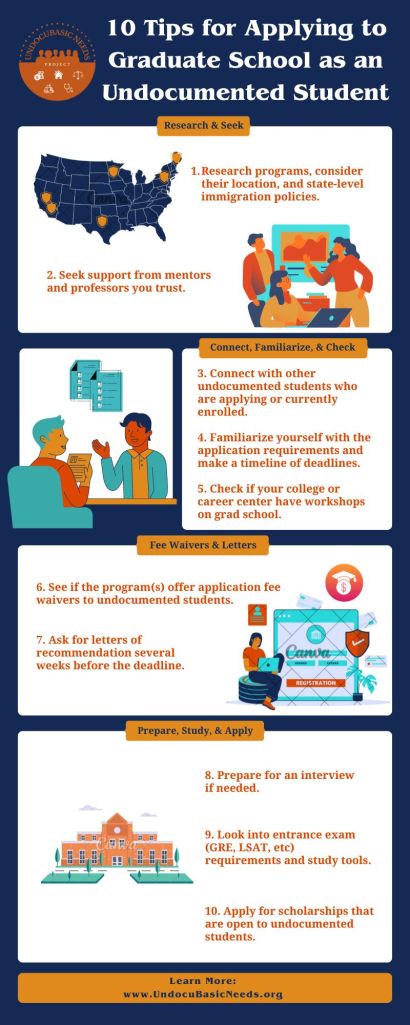
Many graduate school programs require students to take an examination test before they apply. As an undocumented student, it is important to figure out what types of identification requirements the testing center expects you to have before you take the exam. This allows you to have enough time to determine whether you have the necessary forms of identification ready or if you will need to apply for them as part of a separate process/timeline. (Check out our tips about these exams in the section below.)
Graduate schools also look at your undergraduate transcripts. More selective graduate programs will generally prefer a higher GPA (3.0 or above) though for specific GPA requirements, it is important to consult with the program you are considering.
Many graduate schools also ask for a Curriculum Vitae (CV) or resume that demonstrates your work and volunteer experience, personal achievements, club participation, and skills. This is a document you can work on early and circulate with your mentors for advice and feedback.
“I think even now that I’m applying for grad school, there’s been those fears of, you know, are they going to ask me for my social? Or are they going to ask me for proof of residency or something? I just feel like, that has always been the biggest fear of being turned away because of my status.”
Clarissa, 23-year-old undocumented college student in Illinois.
Programs also often require you to write personal essay(s) and research statements of various lengths. Each program will specify the requirements and prompts for these essays. In general, you will be asked to write about why you want to go to graduate school. These statements can give the program an opportunity to learn more about your background. Sometimes, undocumented students may disclose their immigration status in their personal essay though please note that this is not a requirement and largely depends on your own personal circumstances, comfort level, and other factors (more on this below).
Many graduate schools ask for three or more letters of recommendation to determine a student’s fit with the program. A letter of recommendation usually comes from a professor, employer, or mentor. It is ideal to ask your mentors for a letter of recommendation at least four weeks before the deadline. Depending on their availability and preferences, they may ask you to write your own letter that they will then edit, or they may write the entire letter on their own. Again, it depends, but it is important to reach out to your potential letter writers ahead of time.
Many graduate school programs require that applicants submit a writing sample which is usually a several page long academic essay. Many applicants will use an essay that they wrote during college, so it may be helpful to keep this in mind as you work on your undergraduate essays.
Information about graduate school entrance exams
There are four common entrance exams required by many graduate schools. Those are the Graduate Record Examination (GRE), Law School Admission Test (LSAT), Medical College Admission Test (MCAT), and the Graduate Management Admission Test (GMAT).
Institutional and organizational support
There are several efforts underway to demystify the graduate school application process for undocumented students, as well as to support undocumented graduate school students in their journeys. UCLA, for example, created a helpful table outlining what funding opportunities undocumented graduate students are eligible for. UCSD dedicated a page that describes how undocumented students can apply for admission to pursue their graduate degree at their institution. In it, UCSD also created a helpful list of frequently asked questions that undocumented applicants may have such as “do I need to have work authorization to apply to a graduate program?” UCM created an Undocumented Grad Student Handbook with important information about educational rights and privacy, funding opportunities for undocumented graduate students (at UCM and beyond), as well as a list of frequently asked questions from prospective undocumented grad students.
In terms of programming, the Undocumented Student Services office at UCSB has robust efforts underway, including the UndocuGrad Exploration Program and UndocuGrad Prep Program which feature workshops, networking opportunities with current grad students, as well as offer hands-on support during the grad school application process. At other campuses like at UCB, efforts are underway to serve the needs of undocumented graduate students through events like UndocuGrads Monthly Support Circles that provide an opportunity for students to connect, support one another, and build community.
There are also several organizations and online platforms dedicated to expanding access to graduate school for undocumented students. This includes My Undocumented Life, which features up-to-date information and resources for undocumented students, their families, and allies, including a page on graduate school. There are also stories by current or former graduate students who identify as undocumented. These can be helpful to learn more about students’ trajectories and pieces of advice. There are also UndocuGrads workshops that are available either in-person or online. Pre-Health Dreamers provides advising and programming to students pursuing advanced degrees in the health and medical fields. Científico Latino is a non-profit organization that aims to support students from minoritized backgrounds in their pursuit of a degree and career in STEM.
Personal stories and additional reading recommendations
As you navigate the graduate school application process, it may be helpful to read about the lived experiences of fellow undocumented graduate students, including their stories of overcoming barriers and finding support.
We recommend reading Norma’s story, featured on My Undocumented Life, where she describes what motivated her to apply to graduate school and what challenges she encountered during the application process. Norma completed her master’s in Theology and her PhD in Clinical Psychology. She was motivated to pursue this path in part “to provide holistic mental health services to the undocumented community that focuses on adolescents and their families.”
Beni also shares his experience navigating the graduate school application process as an undocumented student, including the importance of having a support network. He noted, “I reached out to as many graduate students and undocumented students as I could. They were all very open to helping answer any questions and concerns I had about grad school and being undocumented.”
There are also efforts underway to transform academic spaces and the existing literature in a way that centers the voices of UndocuScholars—individuals who identify as currently or formerly undocumented. To this end, we encourage you to check out the emerging and exciting work of UndocuScholars featured on My Undocumented Life, which includes this helpful reading list and this blog post series.
“I want to pursue grad school, and possibly like higher education to be a psychologist. I want to focus like the first couple years on research studies to see what type of help would benefit the community that I want to help, which is first generation immigrant students […] I want to focus on actually working on the types of therapy or something that I think would benefit them. And I want to try and take it back to Alabama, because there’s been a growing population of Hispanics, or immigrants in general, actually. And I want to be able to give them the resources that they need.”
Gloria, a 19-year-old, undocumented college student in Illinois
Stories about the lives of undocumented graduate school students featured in scholarly research
There is also research underway to better understand the lived experiences of undocumented graduate students. Please note that to the extent possible, we tried to identify research that is free and open to the public. However, some of the links below may prompt you to subscribe or make a purchase to access the full content. If that is the case, we encourage you to first verify that the website you are referred to is working; links may malfunction and domains may change so we encourage you to confirm that the website you are in is trustworthy. We also encourage you to contact your school’s library to inquire about the possibility of obtaining access to the content through your institutional affiliation.
Carolina Valdivia co-authored an article titled, “Education Equity for Undocumented Graduate Students and the Key Role of My Undocumented Life,” in the Journal of College Access. The article is based on her work through the My Undocumented Life online platform since 2011 and focuses on the challenges undocumented students face in their pursuit of graduate school and how a sense of community can support their pursuits.
Gloria Itzel Montiel, Jessica I. Valenzuela, and Iliana Guadalupe Perez published an article titled, “The Emergence of UndocuPhDs: A Critical Testimonio of Latinx Undocumented Students Creating and Documenting the Journey through Doctoral Education,” in Border-Lines: Journal of the Latino Research Center. In the article, the authors discuss their experiences pursuing doctoral degrees and advocating for resources.
Angela Lara and Pedro E. Nava published an article titled, “Achieving the Dream, Uncertain Futures: The Postbaccalaureate Decision-Making Process of Latinx Undocumented Students,” in the Journal of Hispanic Higher Education. The article is based on two years of ethnographic research and interviews with 20 undocumented graduate students. It focuses on undocumented students’ decisions to pursue graduate school.
Jose Luis Zayas wrote his dissertation on the experiences of undocumented students who pursue a postgraduate degree. It is based on interviews with students from across the country, including in California and Utah.
Kevin Escudero is currently leading efforts to understand the educational experiences of undocumented graduate students through surveys and interviews.
APPLYING TO GRADUATE SCHOOL: NEXT STEPS & RESOURCES
“I want to become an attorney, whether that’s like an immigration attorney or like, workers’ rights or in or something of that sort. But definitely, like, the one thing that’s kept me going has been my family, like their experiences with lawyers, their experiences with the law and stuff of that sort. And my own experience, too. So that’s, I think, because I have that motivating me and like, I don’t see myself like not doing that. So, in that sense, I’m, like, grateful that I have this strong drive.”
Leticia, 21-year-old, DACA recipient in California
How to Choose a Graduate School Program/University
Choosing a program will depend on you and your goals, but here are some things to consider when making a decision.
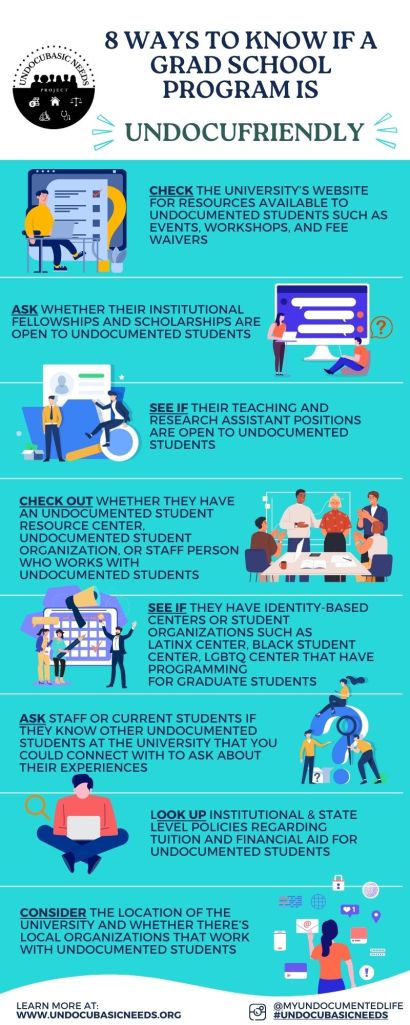
- Institutional support. Visit the school’s website to see how they support and advocate for undocumented students. For example, the university may have an Undocumented Student Resource Center, or staff members who work with undocumented students. Many graduate schools provide academic and career resources. Others provide support groups for undocumented students, so it is helpful to learn more about these programs before you apply.
- Location. It is also important to consider the location of the school. For example, you may want to account for how close the school is to your family, friends, and other types of support. Another thing to consider is that some states, such as New York, Illinois, and California, tend to have more resources on their university campuses for undocumented students such as staff members who have expertise in working with undocumented students. Lastly, it is also important to be aware of checkpoints around the border region and the possibility of being stopped if you choose to attend an institution in this area. The American Civil Liberties Union (ACLU) has created a helpful guide with more information about the border region and these checkpoints.
- Cost. Make sure to consider the cost of attending graduate school, including tuition, health insurance, housing, and other expenses. It is also important to check whether the school provides in-state tuition or state financial aid for undocumented graduate students as well. (More information on how to pay for graduate school below).
- Teaching and research assistant positions. Many universities offer graduate students Teaching Assistant (TA) and Research Assistant (RA) positions. TAs usually assist with a faculty member’s class by conducting discussion or laboratory sections, grading assignments and exams, and holding office hours. RAs are usually hired to assist a faculty member with their research projects. Be sure to ask your program whether TA or RA positions are open to undocumented students on campus (with and without DACA, TPS, or other forms of legal protection).
A note about transitioning from a public college to a private institution for graduate school (or vice-versa)
You may have gone to a public university for college and are considering a private university for graduate school. Or vice versa, you may have gone to a private university and are considering going to a public university for graduate school. Although the decision will depend on various factors, such as the cost of attendance, financial aid available, and your research interests, here are a few considerations to keep in mind:
– Private universities tend to have more flexibility than public universities in determining their admissions and financial aid policies so be sure to inquire about opportunities with the admissions and financial aid offices at the various schools you are considering.
– Some private universities may have smaller student populations so we recommend looking up the faculty to student ratios to see how many students each faculty and staff member is working with. For example, Rice University, a private university in Texas, has a student-to-faculty ratio of 6:1, meaning that for every six students, there is approximately one faculty member. University of Michigan, a public university in Michigan, has a student-to-faculty ratio of 15:1. These ratios may affect how available faculty and staff are for their students so it can be helpful to search information about student-faculty ratios for the programs you are considering.
How to Pay for Graduate School
There are financial resources available for graduate school. Make sure to check out these scholarship opportunities, published by My Undocumented Life, that are open to undocumented graduate students. Immigrants Rising also maintains a list of scholarships that are open to undocumented students applying to graduate school. It is helpful to keep in mind that undocumented students often adopt various strategies to pay for graduate school, including applying for scholarships and state financial aid (if available/eligible), fundraising, and negotiating (based on program acceptances and resources).
Additional Support
“[…] my own experiences as an undocumented student has definitely shaped how I want to go into graduate school and hopefully, after graduate school, and wanting to make people more aware about undocumented stories, undocumented peoples lives in the United States. And wanting to offer myself as a resource or as a guide for other people. And I know that I won’t be able to make people’s lives easier, but I hope that something that I share can help them in whatever way, just things that I’ve struggled with, and knowing where to…. how to address it, and essentially not perpetrating the cycles that I’ve seen in institutions of higher education, for example, and actually knowing how to help undocumented people.”
Maribel, 21-year old undocumented college student in Massachusetts
Organizations
- TheDream.US is a program dedicated to providing college scholarships to undocumented students. They also provide a list of resources specifically for undocumented students who are interested in graduate school.
- The Higher Education Immigration Portal, created by the Presidents’ Alliance on Higher Education and Immigration, is a digital platform dedicated to sharing data, policies, and resources that pertain to undocumented, and other immigrant students. They provide resources for undocumented students interested in graduate school.
Resource guides
- The book The Latinx Guide to Graduate School, written by Genevieve Negron-Gonzales and Magdalena Barrera, contains information about navigating the graduate school process and beyond, including insight specific to undocumented students.
- NYSYLC (New York State Youth Leadership Council), an undocumented youth-led organization based in New York City, created the Undocu Grad School Guide. The guide consists of information and resources to know about as you navigate the graduate school application process, such as how to handle working while going to school as well as how to find internships.
- The University of California has created a webpage for undocumented students interested in going to graduate school in California that features available scholarships specific for undocumented students as well as a guide on entrepreneurship for after graduate school.
- Immigrants Rising created the “Law School Resource Guide for Undocumented Students: Getting to Law School” for undocumented students interested in going to law school that features an application checklist as well as information on credential assembly service (CAS).
- Best Colleges made a “Graduate School Guide for Undocumented Students” who are interested in going to graduate school that features testimonials from graduate students as well as useful FAQs.
- Sheila Cook and Iva Gaylord wrote a resource guide specifically for undocumented students who are looking into graduate school that features state laws specific to graduate schools, a discussion on how to navigate the disclosure process while applying to grad school, and more.
- Jose Magaña Salgado wrote a “Law School Guide” featuring information on how to approach the LSAT, including fee waivers and studying. It also features information on the various factors to consider when selecting law schools to apply to.
- In collaboration with the Dream Resource Center at the UCLA Downtown Labor Center, GRADD published a guide titled, “Grad School Decoded: The Undocumented Way” that features information about admissions essays, tests, resume writing, letters of recommendation, and more. The guide also features helpful sample personal statements where you can see how other undocumented grad school applicants structured their essays, and whether they disclosed their immigration status or not.
- There may be organizations local to where you live or in the university you are interested in going to that may be able to offer support, guidance, and resources for your graduate school application process. Be sure to check out our “Organizations Near You” page for more information!
Frequently Asked Questions (FAQs)
- Can undocumented students who do not have DACA go to graduate school?
- Both DACA and undocumented students who do not have DACA can apply to graduate school. Keep in mind the eligibility requirements, financial assistance, and other types of support may vary by institution and program, and so it is imperative to look into the specific program(s) you are considering for the most up-to-date and helpful information about how to apply and what type of resources are available.
- Can undocumented students go to law school?
- Yes! Please note that you will need to take the LSAT to apply. We recommend checking out the “Law School Guide” written by Jose Magaña Salgado, and the “Law School Resource Guide for Undocumented Students: Getting to Law School” created by Immigrants Rising for more information on the law school application process as an undocumented student.
- What if I don’t have DACA, can I still go to grad school and how may that impact funding and other opportunities?
- Yes! However, it is important to note that funding packages and support may vary significantly based on the institution, program, and state-level policies at the time of applying/attending.
- When attending grad school, will I have to pay in-state or out-of-state tuition fees?
- The answer to this question varies, but generally, it will be important to check the latest policy updates for the state you are considering attending graduate school in. You will also want to check-in with the programs you are considering to receive the latest information about their admission and financial aid policies.
- How can I afford paying for grad school if I am undocumented?
- There are many ways to help you pay for school such as scholarships, fellowships, and internships, many are open to undocumented students as well. Make sure to check out these scholarship opportunities, published by My Undocumented Life, that are open to undocumented graduate students. Immigrants Rising also maintains a list of scholarships that are open to undocumented students applying to graduate school.
- Should I disclose my immigration status when applying to grad school, and if yes, how?
- The decision to disclose your immigration status varies and it is up to you in terms of how best to approach this decision. As you weigh various factors (including, for example, your comfort levels, fears, worries, concerns, and sense of safety/risk), it may be helpful to check-in with trusted mentors or friends.
Last updated on: October 2024
Please keep in mind that this resource page is for informational purposes only and does not constitute or replace professional legal advice. It is important to consult with an experienced and trustworthy immigration representative or attorney to receive answers and support for specific legal questions. Additionally, the information provided is current to the publication of this resource page. Please be sure to verify any authenticity and trustworthiness of links prior to connecting with any resource.
Collection of resources & narrative: Diana Hernandez & Marilyn Morales. Infographics: Eva D. León
 UndocuBasic Needs Project