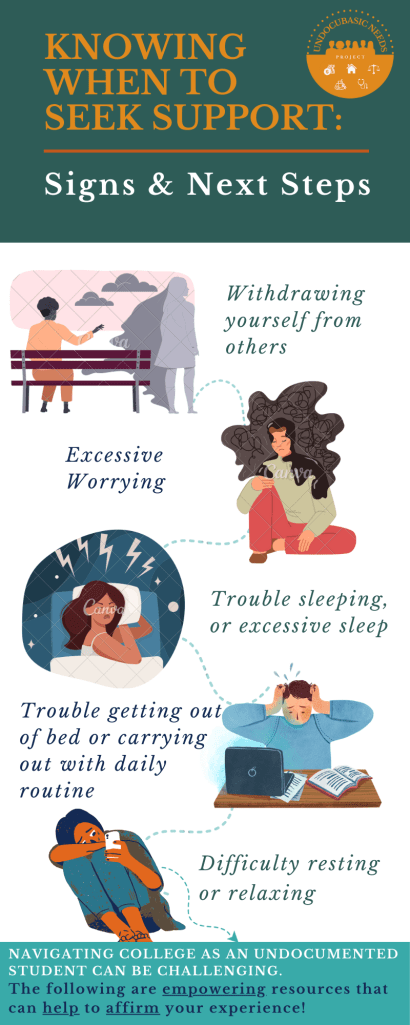
Navigating life as an undocumented student can entail a set of unique stressors such as the fear of deportation, uncertainty of the future, and the instability of DACA. As an undocumented college student, it is imperative that you find ways to care for your own mental health and foster a sense of wellness. There are many ways to seek support and a sense of wellness. This includes, for example, finding support groups, accessing individual therapy, as well as connecting with other undocumented students and students with undocumented family members. We have compiled a list of key information and resources to help you navigate the process of securing support and fostering a sense of wellness.
Please keep in mind that this resource page is for informational purposes only and does not constitute or replace professional advice. It is important to consult with an experienced and trustworthy mental health representative or attorney to receive answers and support for specific questions. Additionally, the information provided is current to the publication of this resource page. Please be sure to verify any authenticity and trustworthiness of links prior to connecting with any resource.
“[…] even though I haven’t seen my family members get deported, I have seen like, friends and stuff, like have family members who were deported. And just seeing them in that state, like, I would imagine myself like, ‘Oh, my God, like, that could be me at any moment.’ You know, so just, I think sometimes there’ll be moments where I’ll just think about it, and I’ll get sad or upset, and I just strive to work harder, because I’m like, ‘I can’t lose my moment,’ if that makes sense. Like, I have to, like, because I haven’t been deported yet. Like, I need to do what I can.”
Vanessa, DACAmented college student in California
In this page, you can find more information about the following:
- Counseling and Support on College and University Campuses
- Finding a Therapist Off Campus
- Online Wellness Support Groups
- Research on Mental Health and Undocumented Students
- Guidance for Expanding Mental Health Support on Campus
- Local Organizations Near You
- Frequently Asked Questions (FAQs)
Counseling and Support on College and University Campuses
“And we also have like, you know, mental health stuff like the wellness center and then we have a nurse practitioner there so I mean, the consult whatever that thing like if you go see her it’s free.”
Annette, undocumented college student in Georgia
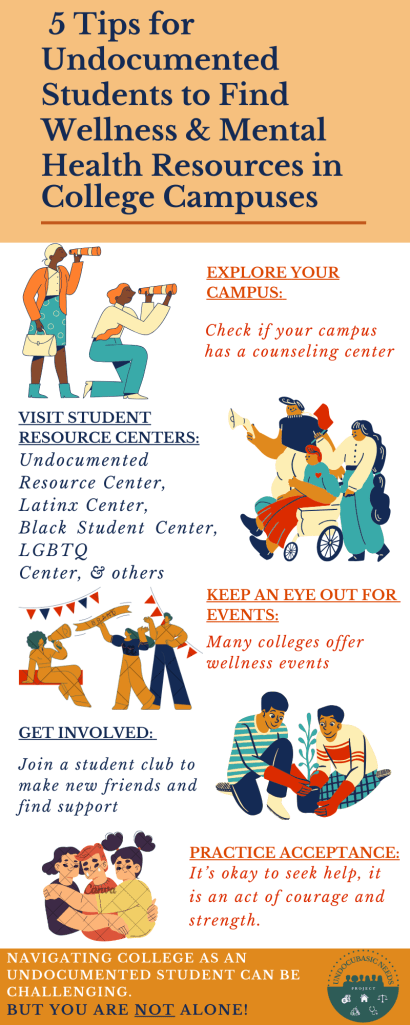
Many college and university campuses have a counseling center that all currently enrolled students can access. These centers may offer students a limited number of counseling sessions with trained mental health professionals on campus. Be sure to ask about whether your campus has a counseling center, and what their services are for students.
If you are a college student, your campus may also have a student-led organization for undocumented students.
You can also see if your campus has an Undocumented Student Resource Center. (Sometimes these are also referred to as Dreamer Resource Centers or Undocumented Student Services). If you attend college in California, check out this interactive map to search for an Undocumented Student Resource Center in your campus. These centers typically have staff trained to work specifically with undocumented students, and may host wellness events for students who identify as undocumented or U.S.-born citizens whose parents are undocumented..
If your campus doesn’t have an Undocumented Student Resource Center, they may have other centers that host wellness and community building events, such as a Black Student Center, Latinx Student Center, LGBTQ Center, or a First Gen Student Center (students who are the first in their family to go to college).
Spotlight on the University of Nevada, Reno
Through the “UndocuPack” initiative, the University of Nevada, Reno, offers a wide range of services and support for undocumented students and students in mixed-status families (where at least one member is undocumented). This includes counseling support for students, UndocuAlly training for faculty and staff, and more. Their counseling support center is open to “all University of Nevada, Reno students regardless of their identities and/or immigration status” and includes services such as anonymous mental health screenings, emergency support, workshops, individual counseling sessions, and much more.
Finding a Therapist Off Campus
“ […] receiving this professional help has helped me take those things off my chest. It’s bettered [sic] my mental health. I’m not as anxious anymore. I’m not as stressed anymore. So it’s kind of given me an improvement for the past year.”
Olivia, undocumented college student in California
Talking to a therapist on a one-on-one basis can be a great way to create a sense of wellness in your life. While finding a therapist may depend on your preferences, access to insurance, costs, and other factors, there are several resources to check out if you need help finding a therapist.
United We Dream, a national undocumented-youth led organization, has a directory with suggestions for therapists who have experience working with immigrant clients. Check out the directory here.
Mayra Veronica Barragan-O’Brien at UndocuMental Health provides a resource page that features online directories to help you find a therapist. These directories are specific to those looking to find a therapist at a low cost and/or therapists who work with individuals with specific identities such as being LGBTQ, Black, Latinx, or Asian.
If you live in California, Immigrants Rising’s Mental Health Connector is a great resource specifically for undocumented individuals who are looking for a therapist.
The UndocuBlack Network, an organization created by and for undocumented Black communities, created a guide for undocumented Black individuals to review when looking for a therapist.
Spotlight on therapists who are openly undocumented
There is a growing community of therapists who openly identify as undocumented. Following these therapists’ websites and social media accounts can be affirming as you learn more about therapy and mental health.
Huyen “Kiki” Vo is a therapist in California who was born and raised in Vietnam. Kiki identifies as a psychotherapist, consultant and speaker. You can visit her website to learn more about her personal trajectory and work.
Dr. Norma Ramírez is a therapist in California who founded All Good Things Psychology, where she offers services such as individual therapy, immigration mental health evaluations, workshops, and more.
Dra. Nancy Rodriguez is a bilingual, DACAmented psychologist who was born and raised in Guadalajara, Mexico. You can learn more about her personal trajectory and work at Healing Corazones Psychotherapy.
Mayra Veronica Barragan-O’Brien is a therapist in California who was born and raised in Mexico. She founded UndocuMental Health which provides a range of services and resources that are tailored to individuals who identify as undocumented, from mixed-status families, or other backgrounds.
Online Wellness Support Groups
Support groups can be a great way to meet other undocumented students and students who have undocumented family members. Talking to other people who have similar experiences as you can also be validating and empowering.
Immigrants Rising, a nonprofit organization that works with undocumented communities, continually hosts six-week online wellness support groups. These wellness support groups have specific focuses such as UndocuBlack communities, Latinx communities, Asian American communities, LGBTQ individuals, dating and finding love, formerly undocumented folks, and more.
Dra. Nancy Rodriguez, a DACAmented psychologist, hosts online support groups for Latinx women who are early in their careers. You can visit her website for more information.
If you live in California or Nevada, Dr. Norma Ramirez, an undocumented psychologist, routinely hosts online support groups for undocumented individuals. To learn more about her groups and sign up, you can visit her website.
Research on Mental Health and Undocumented Students
There is a growing body of research regarding mental health and undocumented students, and students with undocumented family members, on college campuses. Check out these articles:
In this article in the Cultural Diversity & Ethnic Minority Psychology journal, scholars Cecilia Ayón, Basia D. Ellis, Melissa J. Hagan, Laura E. Enriquez, and Carly Offidani-Bertrand explored undocumented students’ use of mental health resources on college campuses in California.
In this article in the Medical Anthropology journal, scholars Ryan I. Logan, Milena A. Melo, and Heide Castañeda explored how racialization, legal status, and oppression can affect the whole family when some family members have documentation and others are undocumented.
In an article in the Latino Studies journal, scholars Josefina Flores Morales and Yuliana Garcia interestingly found that students with DACA reported higher levels of anxiety than undocumented students who do not have DACA, among other findings.
In this article in the Communication Monographs journal, scholars Jennifer A. Kama, Suellen Hopferb, Monica Cornejo, Roselia Mendez Murillod, and Daniela Juarez explored the cultural and structural factors that supported or hindered undocumented college students’ ability to seek mental health services on college campuses.
Guidance for Expanding Mental Health Support on Campus
Several organizations have created resource guides, workshops, and training for professionals seeking to build mental health resources for undocumented students and communities.
United We Dream created a document with guidance on creating support groups for undocumented communities.
The Foundation for California Community College and Immigrants Rising created a guide for college students and practitioners seeking to learn more about how to support mental health and wellness for undocumented college students.
Local Organizations Near You
Undocumented youth and student-led organizations near you may be providing both in-person and online events and resources specific to immigrant and undocumented communities in your state. Connecting with these organizations can help build a sense of supportive community for you and help connect you to resources and other opportunities. Check out this list of organizations.
“ […] I think wellness is a big part because we understand that a lot of us come from families or come from backgrounds where wellness wasn’t really emphasized. So for me, a typical week would be I have past appointments, which are mental health, like with a therapist here on campus, so I have appointments with that on Monday. And she’s actually Mexican, she’s first generation, so she specializes in that. So it’s been really good to talk about a lot of issues that I don’t really feel comfortable talking with other people. So that’s Monday, that’s about an hour and a half every every week. And then I do journaling every night, just to jot down my feelings, my ideas, which again, that came from here, which has been really good. I do a lot of walking, I call it “hot girl walks”, I go around and just walk around. And that’s really nice, because I didn’t grow up in the best neighborhoods, so being surrounded by this kind of just, they look so pretty, all the buildings, listen to music, just have a nice time just to decompress. And I think this this week, or this semester, I’ve started to have a time where I kind of just stopped the homework, stop any work. So not so much being like, ‘oh, like I’ll finish this chapter, I’ll like, start going to sleep when I finish this chapter.’ Also, like having a set time, even if I hadn’t finished. Just so that my boundaries are pretty set in stone. And I had developed that routine. But yeah, other than that, I think friends have been really good, great way to decompress. But I think those main three things have really helped me take care of myself.”
Eduardo, undocumented college student in Rhode Island
Frequently Asked Questions (FAQs)
- How can I find support for undocumented students, or students who have undocumented family members?
- Some colleges and universities have student-led organizations for undocumented students. These organizations can be a great place to connect with other students who are undocumented or have undocumented family members. They may also host wellness events or support groups. There are also organizations off-campus that host virtual support groups for undocumented students.
- Is it possible to find an affordable therapist if I am undocumented?
- Many colleges and university campuses have a counseling center available to currently enrolled students where you can talk to a counselor or a therapist about anything that is on your mind. Be sure to ask whether your campus has a counseling center and what kind of services they offer to students. It is also possible to work with a therapist off campus at a reduced cost though you will want to make sure to ask about fees, sliding scales, and insurance coverage. Moreover, some campuses have resources specifically for undocumented students, and students who have undocumented family members.
- Is it ok to want to get mental health support if I am undocumented?
- Absolutely! It is important for everyone to get mental health support, whether you are undocumented or not. There is even a growing group of therapists and counselors who are undocumented themselves.
- I am an educator and want to learn more about how I can support the mental health needs of my students who are undocumented or have undocumented family members. Where do I learn more about it?
- Several organizations have created resource guides specifically for educators who are asking about how to support their students’ mental health. Check out our section above, “Guidance for Expanding Mental Health Support on Campus”
Last updated on: October 2024
Please keep in mind that this resource page is for informational purposes only and does not constitute or replace professional advice. It is important to consult with an experienced and trustworthy mental health representative or attorney to receive answers and support for specific questions. Additionally, the information provided is current to the publication of this resource page. Please be sure to verify any authenticity and trustworthiness of links prior to connecting with any resource.
Collection of resources & narrative: Diana Hernandez & Marilyn Morales. Infographics: Eva D. León
 UndocuBasic Needs Project