It is estimated that 50% of undocumented individuals in the United States do not have health insurance, compared to only 8% of citizen adults who don’t (KFF). The reality of these statistics demonstrates how difficult it can be to gain access to healthcare and services among undocumented immigrants. That said, although navigating and obtaining quality health coverage and care may seem challenging, there are opportunities that might be accessible. In this resource page, we have compiled a list of key information about physical health-related resources.
Please keep in mind that this resource page is for informational purposes only and does not constitute or replace professional legal advice. It is important to consult with an experienced and trustworthy immigration representative or attorney to receive answers and support for specific legal questions. Additionally, the information provided is current to the publication of this resource page. Please be sure to verify any authenticity and trustworthiness of links prior to connecting with any resource.
In this page, you can find more information about the following:
- Common Terminology
- Resources in Your School
- National Health Insurance Overview
- State Health Insurance Policies & Resources
- Direct Stories of Immigrants and Reports on the Overall Impact of Limited Healthcare Options
- Dental Care
- Frequently Asked Questions (FAQs)
Common Terminology
- Health insurance: Functions as a type of contract that requires the insurer you are covered by to pay most, if not all, of your health care-related costs/bills. In exchange you pay a premium, which is the equivalent of a monthly payment (HealthCare.Gov).
- Affordable Care Act: Law meant to make affordable health insurance available to more people. The law takes a look at the federal poverty level (FPL). For families/households with incomes between the 100% and 400% FPL, subsidies (called premium tax credit) are provided that help lower the cost of health coverage (HealthCare.Gov).
- The Affordable Care Act is not currently available for undocumented individuals. However, there may be some exceptions for individuals, such as DACA recipients. To learn more about the Affordable Care Act eligibility, refer to the section below.
- Federal Poverty Level (FPL): This measures your income which helps some social service providers and programs determine whether you are eligible for programs or assistance. (Healthcare.Gov) Here is a chart of the federal poverty levels.
- Health Insurance Marketplace: This is where individuals can find and enroll in medical insurance which was made by the Affordable Care Act. Healthcare.gov allows you to identify the marketplace in your state.
- Each state has their own restrictions and limitations based on immigration status. It is imperative to learn more about the medical insurance plans available where you live and if needed, take the additional step of talking to a trustworthy social service provider who may be able to help you navigate the process, including any specific questions or concerns you may have.
- Medicaid: This initiative gives free or low-cost health insurance to qualifying individuals. Please note that eligibility for medicaid is determined by state and there are often restrictions and limitations based on immigration status (HealthCare.Gov).
- Full Medicaid is not currently available for undocumented individuals. To learn more about Medicaid eligibility, refer to the section below.
- Children’s Health Insurance Program (CHIP): This initiative gives low-cost health insurance to children or pregnant women who do not have Medicaid or private insurance (Healthcare.Gov).
- The Children’s Health Insurance Program (CHIP) is not currently available for undocumented individuals. However, there may be some exceptions for pregnant individuals in some states. To learn more about the Children’s Health Insurance Program (CHIP) eligibility, refer to the section below.
- Prenatal Care: Services geared towards care for pregnant individuals before birth.
- Emergency healthcare: By law, public hospitals must attend to patients in emergency medical services even if the patient is uninsured due to the “Emergency Medical Treatment and Labor Act, also known as “EMTALA.” This law helps prevent any hospital emergency department that receives Medicare funds (which includes most U.S. hospitals) from refusing to treat patients.”
Resources in Your School
Many colleges and universities have a resource center for basic needs available to their enrolled students. Additionally, many of these universities have a social worker or specific departments and teams that can assist students with getting in touch with assistance related to health care inquiries. Please remember that as a student you likely have access to health services offered on your campus as these are usually part of your fees.
“I was thinking of going to like a chiropractor. I have the insurance of the university so that helps me cover it in case I have anything like that. So, I was thinking if it worsens like if they continue because so far [it] has only been happening for like a week. Yeah, I would definitely have to go but thankfully, much further…”
Andrea, an undocumented college student in California
There are a variety of tips that you can follow to identify undocu-friendly campuses. This is important because undocu-friendly campuses may provide greater support and resources for undocumented students. One of the most important tips to follow is to research the school you are considering beforehand. Some questions to ask yourself: Do they have a health center? If so, who can access these resources? Do they offer health coverage-like programs or services to students? What happens in cases where a student may need specialty services? You should also research if the schools you are considering have an undocu/dream resource center, a student care/support department/network, or if they are considered a sanctuary school/campus. Some reports show that historically Black Colleges and Universities (HBCUs) and faith-based institutions often advocate for undocumented students
Spotlight on select campuses across the country
There are a variety of college campuses across the U.S. that are already supporting undocumented students and helping them connect with off-campus resources. Below we are listing a few college campuses doing just that, which can be used to help you as you consider enrolling or can be used as an example to advocate to bring similar services to your own campus!
Western Washington University has a section on their website that focuses on highlighting the services they offer that are meant to specifically support undocumented students. They have a Student Health Center that serves as a primary care clinic for WWU students.
The University of Colorado |Anschutz Medical Campus provides Undocumented Student Services and highlights local community resources such as Servicios de la Raza and low fee clinics that offer healthcare services or resources in Colorado.
Spotlight on California
Many university and college campuses across California have expanded their services to support undocumented college students, and those in mixed-status families. Below are a few examples of some campuses that are doing just that:
Berkeley’s UndocuHealth recognizes the health care barriers many of their students faced before attending their campus and provides an array of services to address them.
California State University (CSU) Campuses offer free immigration services, health services, with a specific focus on mental health services, and employee assistance programs.
University of California (UC) Campuses offer health and wellness programs, basic needs centers, and student resource centers for undocumented students.
California Community College Campuses offer health assessment and treatment, psychological counseling and crisis intervention, first aid and community partnerships to undocumented students.
National Health Insurance Overview
We acknowledge that many of you may have questions about securing health services and resources outside of the school setting, especially for your loved ones such as parents or siblings. Therefore we have included additional resources all surrounding the medical coverage/care world. In this section, we discuss health insurance. The goal of health insurance is to help make the cost of health care more affordable. Below we have included a general overview of health insurance, including information on the different kinds and how to see if you qualify for health coverage.
Understanding the difference between public vs. private health care
Health insurance can often be expensive which is why many people may not have it. It is estimated that approximately 38.4% of Californians without health insurance are living in poverty (PPIC). Health insurance is offered by both public programs and by private companies. The public programs are offered by the federal government, which are then administered at the state level. Access this guide from the Centers for Medicare & Medicaid Services (CMS) to learn about the basics of health insurance, as well as learn more about the difference between public vs. private health insurance.
Awareness of the limitations in healthcare options for undocumented individuals
Starting on November 1, 2024, DACA recipients may be eligible for affordable health insurance coverage through the Affordable Care Act (ACA). Please note that undocumented individuals without DACA are still ineligible for the Affordable Care Act. The Affordable Care Act (ACA), signed by President Obama in 2010, allows most recipients to purchase insurance for less than $10 a month. Unless there is a qualifying event, such as a birth or a recent marriage, to apply for ACA you need to apply during the open enrollment period which is between November 1 and January 15 every year. You can apply through phone, online, an agent/broker, certified enrollment partner websites, and with a paper application. Here is a helpful checklist of what you may need in order to apply. Additionally, the Children’s Health Insurance Program (CHIP) may offer coverage to uninsured women, regardless of immigration status, as it may consider the unborn child a “targeted low-income child” who is eligible for this program. It is important to remember that CHIP is not available to undocumented individuals and that the eligibility for pregnant women is limited to the rules and regulations of each state. That said, CHIP may be an option for families with mixed-immigration statuses. For example, it may not be available for undocumented parents but available for U.S. citizen children.
What is available to undocumented immigrants
Since undocumented individuals without DACA cannot get health insurance through the Affordable Care Act Marketplace or federally funded programs, coverage may only be available and purchased through private insurance. It is important to note however, that private health insurance costs are often higher than public programs. There are some financial assistance programs available for people with private health insurance and many of these financial assistance programs are programs created by specific hospitals themselves, or they are a result of a partnership with a non-profit organization. To learn more about financial assistance programs, visit the Consumer Financial Protection Bureau’s article on Is there financial help for my medical bills?
To learn more about different healthcare options for undocumented immigrants, visit the GoodRX Health which provides information on safe medicare, emergency medicare, and more. The Center for Medicare and Medicaid Services also created helpful slides with information on Pregnancy, Prenatal Care, and Newborn Coverage Options with particular consideration for immigrant communities. Specific information can be found on pages 9, 21, and 38-40. Additionally, the National Immigration Law Center has a guide with Health Care Coverage (Maps). In these maps, you can learn about what states have expanded their medicaid eligibility to cover lawfully residing children without a waiting period and regardless of immigration status (information found on map 1), as well as what states have expanded their medicaid eligibility, or offer coverage through the CHIP or state funds, to cover lawfully residing pregnant people and provide prenatal care, without a waiting period and regardless of immigration status (information found on map 2).
Information on health coverage and expansions, based on where you live
USA.gov has a Benefit Finder Tool that can help you find government benefits and financial help. Through this tool, you can identify healthcare and medical assistance by state. While doing this, it is important to note that each state chooses the eligibility for their state Medicaid, but mostly every state requires the individual to be a “qualified noncitizen” which usually means a permanent resident. However, as of March 2024, six states (California, Colorado, Illinois, New York, Oregon, Washington) have expanded their coverage to income-eligible adults regardless of their immigration status. For more information on state-specific health coverage, refer to this breakdown of state health coverage for immigrants and implications for health coverage and care by KFF, where you can learn about what states offer some sort of coverage or have expanded the health coverage to include [undocumented] immigrants. You can also read about medicare state expansion through the Washington State Standard, which discusses the expansion of health coverage in an article titled more states offer health care coverage for certain immigrants, noncitizens, and through the Center on Budget and Policy Priorities which released an article with information on States Providing Affordable Health Coverage to People Barred From Certain Health Programs Due to Immigration Status.
Accessing direct services and resources
We recognize that even those who have been living in the U.S. might struggle with understanding the world of health coverage. The website, 211, has a section focused on those who are new to the U.S. that can direct someone to access resources and information on health care.
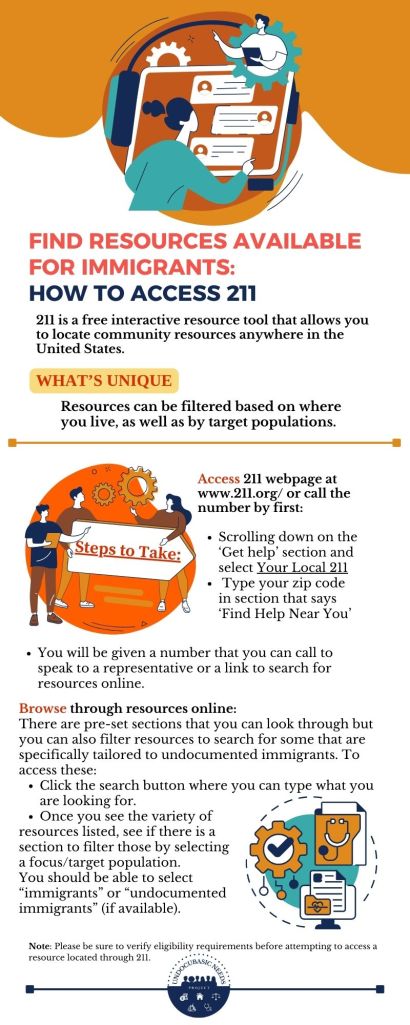
In terms of state-specific support, the National Immigration Law Center made a chart illustrating medical assistance programs available to immigrants in various states. It is also helpful to note that low-cost and free clinics often offer treatment to patients without insurance, many of whom may be undocumented. Many of these clinics may offer services ranging from Primary Care, Physical Therapy, Mental Health Services and Counseling, Prenatal Care, Dermatology, Mobile Healthcare, On-Site Dispensary, Optometry, and Laboratory Services. Most of the programs generally only ask for proof that you reside in the city/neighborhood, proof of income, and some form of identification. Additionally, most typically accept a wide variety of IDs. Here is a website created by the US government where you can locate the closest affordable clinics near you. There are also a few directories that allow you to identify free or low-cost clinics and community health centers near you. Some examples are the Free Clinic Directory and the National Association of Free & Charitable Clinic Find a Clinic database.
If possible, it is always helpful to ensure that any time you are accessing a service, you do your best to ensure it is undocu-friendly. Planned Parenthood created a guide on knowing your rights in health care as an immigrant that can be helpful in staying informed on your rights.
State Health Insurance Policies & Resources
Each state has its own unique set of rules and policies in terms of access to health coverage and insurance. For those who live in states where medical coverage is limited to documented residents, it can be a world of a difference when they are presented with the opportunity to apply for health insurance coverage.
“Yeah, actually, this is the first time I’ve gotten, I felt like a lot of support, like, medical wise, because thankfully, they were also covering my health insurance here. And this is my first time ever having insurance like [school] insurance is my health insurance. And since I lived in Texas, like obviously, we didn’t get insurance. So, it was always like, we’re not gonna go unless we need to go.”
Juliana, a DACAmented college student in California that previously lived in Texas
Although not every state provides health insurance options for undocumented immigrants, we have seen an increase in expansion of health coverage. Below we have included an overview of health insurance coverage including information on the different states that may currently offer or have previously offered health coverage to include immigrants, both documented and undocumented. Even if you do not live in one of these states, having a general sense of what other states offer can be helpful in case there is ever a potential relocation, for example if you go to school outside of your state. The following is state-specific information. For some states, you will find information on states that have been known to offer or previously offered health insurance plans that cover some immigrant communities. For other states, we have included information and direct health care-related resources for undocumented immigrants.
California
The Health Insurance Marketplace in California is called Covered California. Through their page you can obtain information dedicated to defining and understanding the health insurance marketplace in CA. The unique thing about California is their implementation of Coverage for All, which highlights the Medi-Cal expansion implemented on January 1, 2024 allowing more people, regardless of their immigration status, to be eligible for full Medi-Cal benefits (note: Medi-Cal is different from Medicaid). To learn more about the California Medi-Cal Expansion, you can access the ILRC 2024 Medi-Cal Expansion & Public Charge Resources and guides to help eligible Californians understand how to get and keep Medi-Cal coverage for themselves and their families. Additionally, the California Immigrant Policy Center has a Medi-Cal Expansion Resource Hub which provides an array of resources that helps you better understand the medical expansion
Colorado
For undocumented immigrants, there is a program called OmniSalud that allows undocumented immigrants to compare health insurance plans that may be available to them and their families. To learn more about OmniSalud, you can find an easier-to-understand visual here in both English and Spanish. The Department of Regulatory Agencies also provides a general overview of the OmniSalud plans. Separately, there are efforts to expand health coverage in Colorado. The Colorado Department of Health Care Policy & Financing Cover All Coloradans provides information on the upcoming “Cover All Coloradans” program that, if enacted, will include Health Benefits for Children and Pregnant Persons regardless of their immigration status. To learn more about the current health coverage expansion in Colorado, you can visit the Colorado Immigrants Right Coalition that has Healthcare For All information and New Health Insurance Guide. There is also an UndocuHub which is a resource page that allows you to stay up to date with news, information, and healthcare-related resources.
Connecticut
There is a public health coverage program called HUSKY Health for Children and Adults that may provide coverage to those that are not eligible for coverage through medicaid. For postpartum care, HUSKY Health offers State HUSKY A postpartum care that provides 12 months of postpartum-care to recently pregnant non-citizen individuals of any age who do not qualify for Medicaid due to immigration status. You can access FAQs about this expansion in English and Spanish. Additionally, for children ages 0-5, HUSKY Health offers State HUSKY A and State HUSKY B coverage expansion to cover children aged 0-15, who do not qualify for regular HUSKY A and HUSKY B due to immigration status. Access this resource sheet for additional information. For anyone else outside of these demographics, Access Health CT includes information on how immigration status affects your eligibility for enrolling in a health insurance plan in Connecticut. You can also check the Medicaid (HUSKY Health) & Children’s Health Insurance Program (CHIP) eligibility to see if there are any options available to you.
For DACA recipients, as of the publication of this resource page, DACA recipients are not eligible to enroll in HUSKY Health Programs, including medicaid or the Children’s Health Insurance Program (CHIP).That said, according to Access Health CT, starting November 1, 2024, DACA recipients will be considered lawfully present for purposes of applying for Marketplace coverage. Eligible applicants will be able to enroll in Qualified Health Plan (QHP) and/or Stand-Alone Dental Plan (SADP) through Access Health CT.
There is also an Immigrants Coalition called Husky 4 Immigrants that is fighting to ensure all CT residents can access healthcare regardless of immigration status or age.
Denver
Denver Health has a page with information and resources for immigrant and refugee patients at Denver Health (a known health care service provider) including information on Immigrant and Refugee Patient rights at Denver Health, FAQs, and additional resources.
Illinois
Illinois Department of Healthcare and Family Service provides information on the All Kids insurance program that allows children 18 years or younger to be eligible for quality health coverage regardless of immigration status or health condition. For adults, there are currently some important updates: The Illinois Department of Healthcare and Family Services offered the Health Benefits For Immigrant Adults and the Health Benefits For Immigrant Seniors, both meant to provide coverage to immigrant adults. For adults ages 42-64, as of January 1, 2024, other than those with private insurance, those who were covered under HBIA were moved to managed care. For seniors ages 65 years or older, as of January 1, 2024, other than those with private insurance or eligible through spend-down, those who were covered under HBIA were moved to managed care. According to the Illinois Department of Healthcare and Family Services, “everyone enrolled into these programs will have to start paying copays of $100 to $250 for hospital visits that are not eligible for matching federal reimbursement.” Enrollment into the HBIA and HBIS programs are currently paused and it is not recommended to submit new applications. For direct Illinois resources: The Illinois Coalition for Immigrant and Refugee Rights created an interactive map which shows where you can find low-cost or free health clinics in the state of Illinois that are available for people regardless of their immigration status. Additionally, the Illinois Coalition for Immigrants and Refugees provides healthcare resources for immigrants and refugees including an interactive map of all of the health clinics in the state of Illinois and Know Your Rights information.
Maine
As of 2022, non-citizen children and pregnant individuals living in Maine have been eligible to apply for MaineCare for Immigrants and/or the Children’s Health Insurance Program (CHIP), and do not have to worry about any “five-year bar”*. For direct Maine resources: Maine Immigrant Youth Resource Guide lists information and resources on Emergency Care Providers and Additional information for the immigrant community. Dental information and resources are also included.
Massachussetts
If they are eligible and meet financial guidelines, pregnant individuals in any noncitizen group may be eligible for full MassHealth benefits while they are pregnant and for 12 months postpartum. Additionally, children under the age 19 who are other noncitizens may be able to get the Children’s Medical Security Plan (CMSP) through MassHealth. For direct Massachusetts resources: A guide by the Massachusetts Government for healthcare information for Massachusetts, includes information on ICE enforcement activities and protecting patients.
Minnesota
A guide by the MN House Research for healthcare for noncitizens in Minnesota. It focuses on the eligibility of noncitizens for health care and cash assistance programs.
New Mexico
The New Mexico Center on Law and Poverty created a resource guide called “Resource List: Health Care for Immigrants in New Mexico” where you can find information about whether to disclose your immigration status with doctors, emergency health care, and low cost clinics specifically in the state of New Mexico.
New Jersey
Children younger than 19, regardless of their immigration status, can qualify for coverage under NJ FamilyCare. For direct New Jersey resources: A guide showing who qualifies for healthcare in New Jersey by the New Jersey Family Care.
New York
Children younger than 19, regardless of their immigration status, can qualify for coverage under Child Health Plus. Separately, New Yorkers can learn more about NYCare, a healthcare program similar to health insurance for NYers who do not qualify. New York City Health Insurance provides information on health insurance options, how to apply, low-cost care, and additional information through the Immigrants Health Insurance Information page and this guide for healthcare for immigrants. For direct New York resources: You can find information on comprehensive and limited health insurance coverage, free or lower cost health care services, pharmacy assistance and other care services, etc through this Guide to Health Insurance and Health Care Services for Immigrants in New York City. Additionally, the New York Immigration Coalition provides Community Resources for Immigrant NYers and has a specific section on Health & Safety Resources that includes helpful guides and KYR sheets. Lastly, Immigrant Health Care contains a variety of links, like a map of community health centers in NYC.
Oregon
Eligible children younger than 19, regardless of their immigration status, may qualify for coverage under Oregon Health Plan. Information for adults can be found through the Oregon Health Insurance Marketplace- Health coverage for immigrants. For direct Oregon resources: The 2024 Health Plan Comparison Tool for Individuals and Families allows people to compare health insurance plans and see if there is any option that you and/or your family is eligible for. Additionally, the Immigrant and Refugee Community Organization provides Health & Wellness Services that address the health and wellness needs of immigrant and refugee communities. Lastly, the Oregon Department of Human Services has a department called the Office of Immigrant and Refugee Advancement that has put together a variety of resources for new arrivals, including information on food, shelter and medical services.
Pennsylvania
The Pennsylvania Health Law Project made a resource guide titled “Health Care for Immigrants: A Manual for Advocates in Pennsylvania” that helps identify what, if any, resources and coverage is available for immigrants in Pennsylvania.
Rhode Island
Eligible children under the age of 18 and pregnant individuals may be able to apply for health coverage through the RIte Care Program. You can also find additional health coverage information for children through the Immigrant Coalition of Rhode Island- Coverage for All.
Utah
Eligible children younger than 19, regardless of their immigration status, may qualify for coverage under State Children’s Health Insurance Program (CHIP). It is important to note however that funding was estimated to cover roughly 2,000 children.
Vermont
Eligible children younger than 19 and pregnant individuals, regardless of their immigration status, may qualify for coverage under Immigrant Health Insurance Plan (IHIP), and state-funded health care program who have an immigration status for which Vermont Medicaid is not available (except for Emergency Medicaid).
Washington
Washington State Healthcare Authority provides information on coverage for Noncitizens (children and adults) who can be covered through the Apple Health Expansion. Please note that the enrollment limit for the Apple Health Expansion program is currently met. Individuals who have not applied may be able to apply in case spaces open up in the near future. For direct Washington resources: Through the Washington HealthplanFinder, you can learn more about any other Health Care Options for Immigrants. A table is provided that lists who is eligible for different Full-coverage options. Additionally, Community Health Plan of Washington – Community Health Centers has a Provider Search Tool that allows you to identify a variety of healthcare providers near you.
DC
Eligible children younger than 21, regardless of their immigration status, may qualify for coverage under Immigrant Children’s Program. Individuals older than 21 who do not qualify for other health insurance programs due to their immigration status may qualify for coverage under DC Healthcare Alliance. Additional information can be found through the DC Healthcare Alliance Q&A.
“[…] I was able to go to this hospital nearby and it was able to get covered by [that] insurance [that] my mom had found. But I’d say when it comes to not having that, like, previous years, I usually just have to look for clinics that have like discounts available. So yeah, it’s a little bit uncertain when I don’t have that insurance. But luckily, right now I do.”
Daniel, an undocumented college student in Colorado
Direct Stories of Immigrants and Reports on the Overall Impact of Limited Healthcare Options
There are many stories of negative experiences with health care as an undocumented immigrant. Take for example Denise’s story- No longer afraid: an undocumented immigrant’s experience in American health care where she discusses navigating and working in the US healthcare after her own mother was denied care due to her immigration status. Frontline PBS also released a short documentary titled Undocumented in the Pandemic that focused on the story of a family where the father was in a detention facility during the onset of the COVID-19 pandemic. This documentary highlights the lack of consideration for undocumented immigrants’ health, especially those in custody, during the pandemic. WHAS11 released a report that focuses on the lack of health coverage and how it impacts the immigrant community focusing on the story of an immigrant woman who was taken to the emergency room due for kidney surgery but was left with a bill that she would not have the means to pay for. Michigan Medicine released a video focusing on the impact of Health Care for Undocumented Immigrants due to a hostile political climate. Emergency Healthcare: Freedom Care provides information on the The Basics of Emergency Medicaid while Centers for Medicare & Medicaid Services discusses what the Emergency Medical Treatment and Labor Act (EMTALA) is and highlights that you have rights in an emergency room.. You can also find additional information on the Emergency Medical Services through American College of Emergency Physicians- Understanding EMTALA.
Academic studies
To learn more about the additional ways undocumented immigrants access healthcare, check out this report written by Mike Nicholson on The Role of Faith-Based Organizations in Immigrants’ Health and Entrepreneurship that discusses how forming trustworthy relationship between religious groups and the community can be helpful for healthcare expansion advocacy and trusted referrals. Additionally, Karen Hacker and colleagues authored a literature review titled, “Barriers to health care for undocumented immigrants”, which discusses issues related to policy impacting undocumented immigrants in part through the fear of deportation, stigma, and other factors. Lastly, Rebecca Woofter and May Sudhinaraset discuss the impact on access to healthcare between those who may have DACA protections and those who do not in a report titled, “Differences in Barriers to Healthcare and Discrimination in Healthcare Settings Among Undocumented Immigrants by Deferred Action for Childhood Arrivals (DACA) Status.”
Dental Care
According to the National Library of Medicine, “more than one-half of noncitizens (50.5%) received a diagnosis of periodontal disease, and 38.0% had caries; for natives, these rates were 34.4% and 27.0%, respectively.” (NIH 2018). Not all health insurance plans include dental coverage and high-cost dental procedures can deter undocumented communities from seeking any care at all. Below we have included a resource that can serve as a starting point for identifying quality services, regardless of your immigration status.
Identifying quality care
SABEResPODER provides information on Dental care for undocumented immigrants. This resource has links to resources that can help find dental information and services to immigrants such as community health centers financed by the federal government, dental programs affiliated to schools and universities across the country, clinical trials through the National Institute of Dental and Craniofacial Research, and community clinics financed by local or state resources. Some dental clinics may offer sliding scale services to their local community and do not require insurance or require you to be a citizen.
Frequently Asked Questions (FAQs)
- Do I have to disclose my immigrant status in a clinic/hospital?
- No. To learn more about disclosing your status as well as your rights as a patient, visit GoodRx’s guide on Healthcare for Undocumented Immigrants: Your Rights to Insurance, Care, and Privacy
- What are my rights as an immigrant when seeking medical assistance?
- Regardless of your immigration status, you have rights. Stay up to date with the rights you may have an an undocumented immigrant when seeking health care/coverage information by visiting the Immigration Forum’s Fact Sheet: Undocumented Immigrants and Federal Health Care Benefits
Last updated on: October 2024
Please keep in mind that this resource page is for informational purposes only and does not constitute or replace professional legal advice. It is important to consult with an experienced and trustworthy immigration representative or attorney to receive answers and support for specific legal questions. Additionally, the information provided is current to the publication of this resource page. Please be sure to verify any authenticity and trustworthiness of links prior to connecting with any resource.
Collection of resources & narrative: Gladys Guzman
 UndocuBasic Needs Project